HEALTH & MOVEMENT
Osteopathy as a global view of the horse
We do not treat a lameness. We do not treat a vertebra. We treat a whole organism.
Very often, the consultation begins like this: “He has a lameness.” “He struggles with that rein.” “He doesn’t want to canter.”
And although the symptom appears in one specific place, the origin is rarely only there.
The horse’s body does not work as isolated parts. It works as an interconnected system.
In summary
- 🔎 We do not treat the symptom alone, we assess the whole.
- 🐴 Movement is the true indicator of health.
- 🧠 The nervous system influences the body as much as structure does.
- ⚖️ A compensation today can become an injury tomorrow.
- 🌿 Osteopathy seeks balance, not just correction.
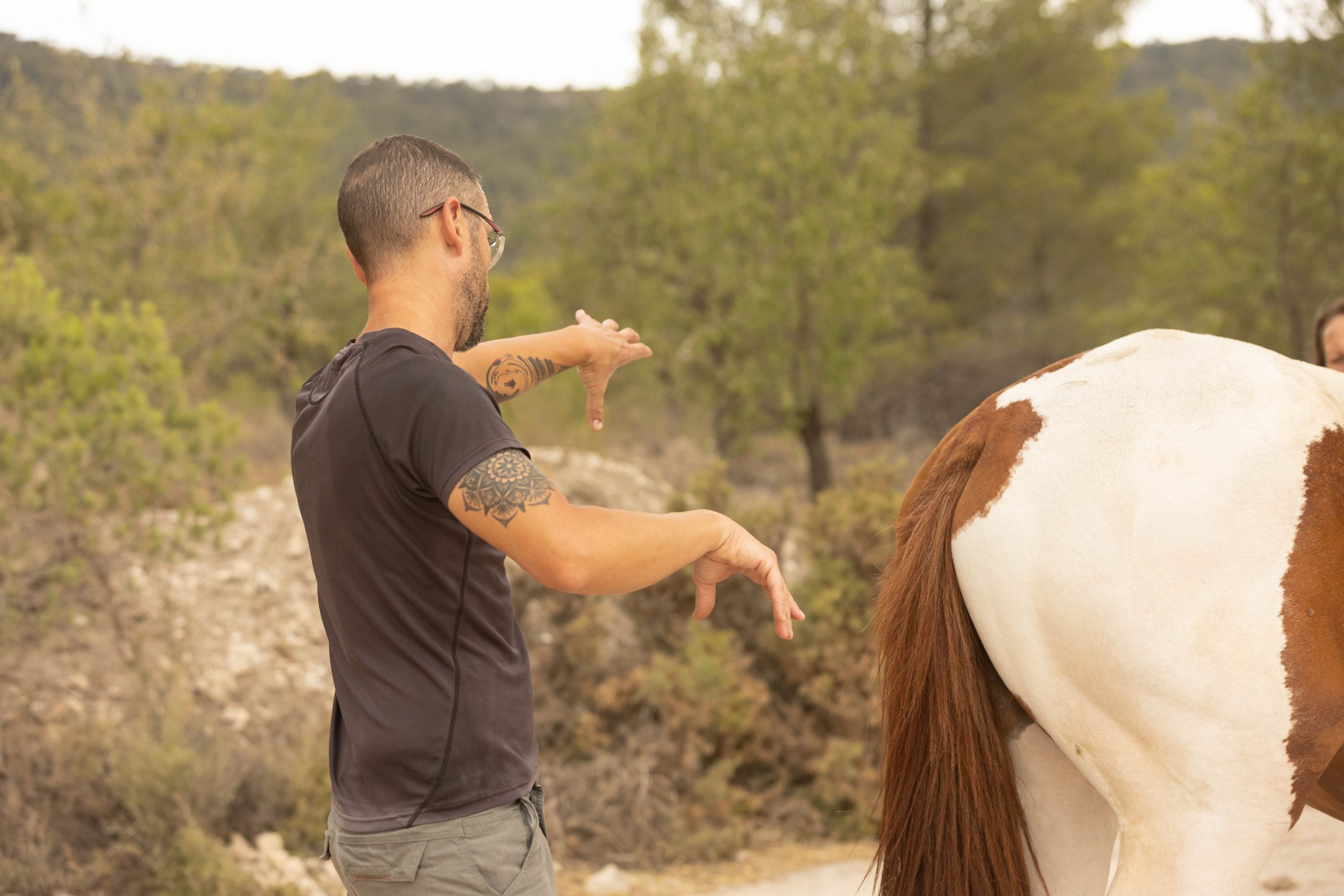
Lameness is information, not the whole problem
When lameness appears, the body has often been adapting for some time already.
The pain may show in one limb, while the cause may lie in:
- A restriction through the back.
- A blockage in the pelvis.
- Tension in the neck.
- An old compensatory pattern.
That is why equine osteopathy does not focus only on the area that “hurts”.
It evaluates the horse globally: at rest, and above all, in movement.
Movement as a map
Movement reveals what the body is trying to compensate for.
Asymmetries. Stiffness. Changes in rhythm. Small resistances.
Nothing appears out of nowhere. The body always gives signs first.
That is why observation matters so much, rather than simply trying to “correct” what is visible.
If you would like to explore this approach further, you can read more about our work in Equine Osteopathy .
Everything is connected
The back influences impulsion. The pelvis influences balance. The jaw can influence the topline.
And rest influences everything.
As we explained in the previous article about the importance of rest in horse training , recovery is part of the horse’s global balance.
Without proper rest, the body cannot integrate the treatment.
We do not treat parts. We treat systems.
Osteopathy is not only manipulation.
It is assessment. It is understanding. It is the relationship between structures, tissues, the nervous system and the management of training.
Working on one small area alone may bring temporary relief.
Working with the whole creates real and lasting change.
Kine Equus conclusion
A horse is not a collection of separate parts. It is a living organism in constant adaptation.
Listening to movement, understanding compensations and working with the whole is the foundation of coherent health.
Because when the whole system finds balance, performance comes as a consequence.